Jonathan Nwokpor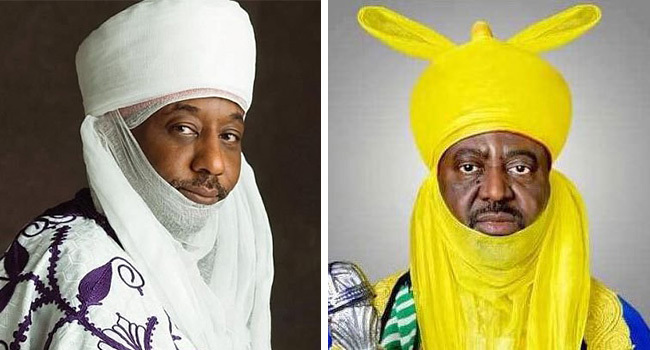
Keep up with the latest news and be part of our weekly giveaways and airtime sharing; follow our WhatsApp channel for more updates. Click to Follow us
The defection of Governor Abba Kabir Yusuf to the All Progressives Congress (APC) has introduced new uncertainty into the long-standing Kano emirship crisis. This development raises an important question: Will this political realignment resolve the dispute, or will it complicate an already fragile situation further?
Kano has experienced an unparalleled royal standoff for almost two years, with two emirs vying for the same esteemed position.
While the 15th Emir of Kano, Aminu Ado Bayero, is based at the Nassarawa mini-palace, Emir Muhammadu Sanusi II operates from the historic Gidan Rumfa Palace.
Each has the support of opposing political and institutional forces.
The Genesis of the Crisis
The crisis can be traced back to March 2020, when Emir Sanusi Lamido Sanusi was deposed by former governor Abdullahi Umar Ganduje on the grounds of alleged insubordination, and Aminu Ado Bayero was appointed as his successor.
However, many observers connected the decision to political differences, especially Sanusi’s perceived closeness to Senator Rabiu Musa Kwankwaso.
Im Mai 2024 schwang das Pendel erneut. Under the leadership of Abba Kabir Yusuf, the NNPP government annulled the 2019 emirate law, dissolved the five emirates established by that law, and reinstated Sanusi as the Emir of Kano.
The action reinstated a single-emir structure but sparked new legal disputes, as Bayero contested his removal in court.
Defection Alters the Political Equation
The political landscape has been changed by Governor Yusuf’s recent switch to the APC.
Yusuf’s membership in the ruling party has aligned him with Ganduje and Deputy Senate President Barau Jibrin, who are seemingly seen as allies of Bayero.
The defection represented a significant rupture with Yusuf’s previous political mentor, Senator Kwankwaso, who was thought to have played a role in Sanusi’s reinstatement.
This adjustment immediately spurred conjecture that the disagreement over the emirship might be reconsidered in the context of a wider reconciliation within the APC.
Government Signals Discussion
The speculation intensified after Ibrahim Abdullahi Waiya, the Commissioner for Information and Internal Affairs, hinted that the crisis might soon be resolved.
“Now we will sit down and resolve such problems calmly. These issues will no longer be difficult. There will be discussions; where apologies are needed, they will be offered, and where forgiveness is required, it will be granted. In some cases, someone may be asked to make sacrifices for the sake of peace,” Waiya said during a radio programme.
His remarks were broadly seen as an indication that political dialogue could be considered instead of extended litigation.
Gov Yusuf: Sanusi Continues as Emir
With speculation increasing, Governor Yusuf took action to establish a clear demarcation.
He spoke via his spokesman, Sanusi Bature, and emphasized that there were no intentions to depose Emir Sanusi.
“There is no plan to replace Emir Sanusi on the throne of Kano. The appointment of the emir was done after the emirates law had been repealed, and there is no plan at the executive level for any further amendment,” the governor said.
“Emir Sanusi remains the Emir of Kano. This defection to the APC will not change the status quo.
Bayero Camp Rebuffs
The camp of Emir Aminu Ado Bayero has dismissed any discussions of a negotiated settlement, despite the governor’s assurances.
Aminu Babban Dan Agundi, Sarkin Dawakin Babba, who initiated the legal challenge against the Kano State Government, stated that the matter is strictly for the courts.
“There is no negotiation that can lead to the removal of Emir Aminu Ado Bayero. The matter is before the courts, and no one has the authority to give judgment except the court. Everyone should wait for the Supreme Court’s decision,” he said.
Settlement Remains Possible – Legal Experts
Legal analysts argue that a settlement is not legally precluded while the matter is in court.
According to Barrister Umar Usman Dan Baito, who teaches at Northwest University in Kano, and spoke to DAILY POST, Nigerian law permits settlement at any stage of the process.
“Even if a case is before the Supreme Court, parties can still reach a settlement through Alternative Dispute Resolution (ADR). Once the court adopts the agreement, the case comes to an end,” he said.
Resolution or Complication?
Theoretically, Yusuf’s switch to the APC could establish a basis for political agreement; however, it has intensified distrust and entrenched positions among the opposing factions.
The court has not yet issued final rulings, and political interests continue to overlap with traditional authority, leaving the emirship struggle delicately poised.
The outcome of the governor’s defection in terms of unlocking a lasting resolution or further complicating the crisis is contingent on how political dialogue, legal processes, and traditional reconciliation are handled in the upcoming weeks.
Please don’t forget to “Allow the notification” so you will be the first to get our gist when we publish it.
Drop your comment in the section below, and don’t forget to share the post.