Mazi Nwokpor Jonathan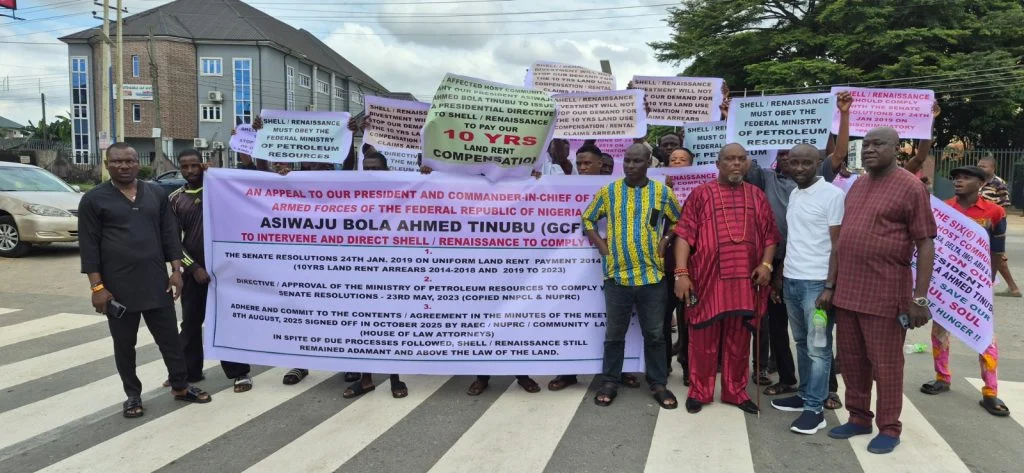
Keep up with the latest news and be part of our weekly giveaways and airtime sharing; follow our WhatsApp channel for more updates. Click to Follow us
There was a heavy protest in Port Harcourt, the Rivers State capital, on Thursday after more than 100 oil-producing communities and families took to the streets over alleged unpaid entitlements.
Our correspondent, who monitored the development, reports that representatives of oil-producing communities from six Niger Delta states converged on the gate of Renaissance Africa Energy Company Limited in Port Harcourt, demanding the payment of about N87 billion allegedly owed as outstanding ground rent.
The protesters said the money represents ground rent allegedly owed by the former Shell Petroleum Development Company of Nigeria, SPDC, now Renaissance Africa Energy, covering the period from 2014 to 2023.
The affected communities are located across Rivers, Bayelsa, Delta, Imo, Akwa Ibom and Abia states.
The communities are also seeking the harmonisation of payments and the adoption of a uniform rate of N600,000 per hectare, arguing that the different rates previously paid to some oil-bearing communities amount to discriminatory treatment.
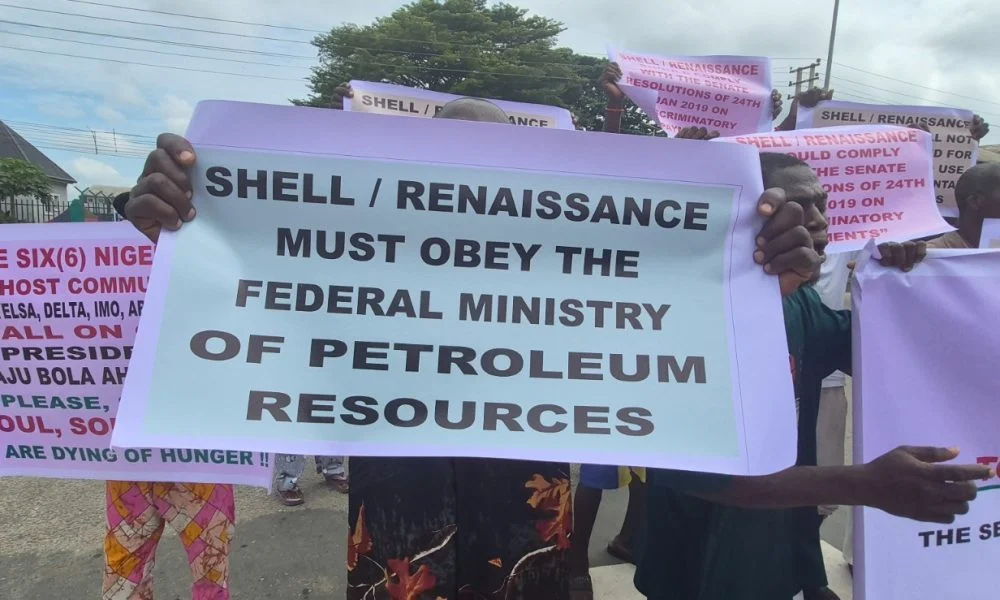
The protesters displayed placards bearing various messages, including, “Shell/Renaissance must obey the Federal Ministry of Petroleum Resources”, “Shell/Renaissance should comply with the Senate resolutions of 24th Jan, 2019 on discriminatory “payments””, and “Shell divestment will not stop the payment of our 10 years land rent arrear”, among others.
Speaking during the demonstration, Chief Ayiba Job of Azagbene Community in Bayelsa State, who represented the affected oil-bearing communities, accused SPDC, now Renaissance Africa Energy, of failing to respond to the demands of the communities.
Job said the communities had earlier petitioned the Senate over the matter, which subsequently resulted in a Senate resolution concerning payment of the ground rent.
He explained that the affected communities are entitled to ground rent payments every five years, noting that payments covering the 2009 to 2014 period later resulted in disagreements over the varying rates paid to different communities.

Job said, “They pay our community, particularly my community, Azagbene, they pay us N200,000 per hectare and Bonny (Rivers State), Focados (Delta State), Shell Residential Area (Rivers State) N600,000 per hectare. So, how could that be? It’s not proper.
“I am producing the oil, and you’re giving my money out, instead of giving us the rights given to other people, paying them higher than we that are producing the oil. And we say no, it’s not proper, the right thing should be done.”
He stated that the Senate resolution reached in March 2019 provided for a uniform payment of N600,000 per hectare, but alleged that SPDC, now Renaissance Africa Energy, had failed to implement the resolution.
Job further disclosed that the company subsequently approached the Federal High Court in Abuja to challenge the Senate resolution, but said the case was struck out.

He clarified that the ground rent does not cover all oil-producing communities, but applies specifically to communities whose lands were acquired between 1970 and 1978.
According to him, SPDC paid N40,000 per hectare in 2009 before the rate was reviewed in 2014, resulting in some communities receiving N200,000 per hectare while others were paid N600,000.
Explaining his concerns over the payment arrangement, Job said, “There’s no way a tenant will wake up one day and say to his landlord, this is what I will pay you. It’s not one anywhere. Renaissance or SPDC, they are tenants to us. We’ve been taking care of them, they should also consider us.
“If you want to make anything like this negotiation, you must call the right people at the right time, negotiate an agreement. The landlord will tell you this is what I want.”
Job also alleged that SPDC, now Renaissance Africa Energy, had failed to provide an explanation for why some communities were paid higher rates than others.
He added that the relevant government agencies were already aware of the dispute.
The protesters consequently appealed to President Bola Tinubu to intervene by directing Renaissance Africa Energy to comply with the Senate resolution and settle what they described as outstanding ground rent arrears owed to the oil-producing communities.
Renaissance Africa Energy’s Vice President, Relations and Sustainable Development, Mr Igo Weli, who represented the company during the protest, said the matter was already being handled by relevant government agencies.

Weli urged the protesters to allow the authorities to resolve the dispute in accordance with the Constitution and existing joint venture agreements.
He said the company recognised the communities and individuals from whom it acquired land and possessed documentation indicating that it had fulfilled its obligations under the agreements.
“We know our landlords, the people who we took land from. We have documents from those who we got land from.
“We have paid them what we agreed, and they signed off our documents. So, we are not losing sleep over this because we are in good terms with our landlords,” he said.
Weli added that the company renegotiates lease agreements with landlords whenever existing agreements expire, in accordance with its established procedures.

Please don’t forget to “Allow the notification” so you will be the first to get our gist when we publish it.
Drop your comment in the section below, and don’t forget to share the post.